| .github | ||
| clogframe | ||
| demos | ||
| doc | ||
| source | ||
| static-files | ||
| templates | ||
| test | ||
| tools | ||
| tutorial | ||
| .gitattributes | ||
| .gitignore | ||
| ANDROID-TERMUX.md | ||
| clean | ||
| clog.asd | ||
| CODE_OF_CONDUCT.md | ||
| CONCEPT.md | ||
| LEARN.md | ||
| LICENSE | ||
| MACOS.md | ||
| make-builder | ||
| make-builder.bat | ||
| make-docs | ||
| make-docs.bat | ||
| NATIVE.md | ||
| README.md | ||
| run-builder | ||
| run-builder.bat | ||
| run-render | ||
| VSCODE.md | ||
| WEBSERVER.md | ||
| WINDOWS.md | ||

CLOG - The Common Lisp Omnificent GUI
David Botton david@botton.com
License BSD 3-Clause License
Learn to program Common Lisp and CLOG here - LEARN.md
Video of CLOG Builder in action

The Common Lisp Omnificent GUI, CLOG for short, uses web technology to produce graphical user interfaces for applications locally or remotely. CLOG can take the place, or work alongside, most cross-platform GUI frameworks and website frameworks. The CLOG package starts up the connectivity to the browser or other websocket client (often a browser embedded in a native template application.)
CLOG - Technical Overview and Purpose CLOG - Reference Manual
STATUS: CLOG and CLOG Builder 1.8 released.
CLOG is actually based on GNOGA, a framework I wrote for Ada in 2013 and used in commercial production code for the last 10+ years. CLOG itself is already used in commerical products, corporate websites, and other opensource projects.
CLOG is being actively extended with new tools and new custom controls but the core API is stable and proven, the Builder is rich in features. Check the github discussion boards for the latest.
Some potential applications for CLOG:
- Cross-platform GUIs and Reports
- Secure websites and complex interactive web applications
- Mobile software (CLOG Runs native on Android and iOS)
- Massive multiplayer online games
- Monitoring software for embedded systems
- A fun way to teach programming and advanced multi-tasking parallel programming techniques. (CLOG is a parallel GUI)
- And the list goes on
The key to CLOG is the relationship it forms with a Browser window or Browser control compiled to native code. CLOG uses websockets for communications and the browser to render a GUI that maintains an active soft realtime connection. For most CLOG applications all programming logic, events and decisions are done on the server which can be local, or remote over the web.
CLOG is developed with ECL and SBCL, it is tested fairly regulary on Linux, Windows, Android, Rasperry Pi, and Mac. It should in theory work out of the box on any system with Quicklisp (although you could hand install) and CLACK (easily switched out and the ecl Android/iPhone branch for example doesn't use).
CLOG is in QuickLisp (ql:quickload :clog), however I recommend
cloning CLOG into ~/common-lisp directory [or other quicklisp/asdf
findable directory (push #P"path/to/dir/of/projects" ql:*local-project-directories*) ]:
For git (you need the ace editor plug in for the builder too from git):

cd ~/common-lisp
git clone https://github.com/rabbibotton/clog.git
git clone https://github.com/rabbibotton/clog-ace.git
git clone https://github.com/rabbibotton/clog-terminal.git

For now one, until fix integrated, should also clone a branch of fast-websockets
if using larger files in the builder:

https://github.com/rabbibotton/fast-websocket.git

To update in the future go to the created directories and type:

git pull


To add UltraLisp to QuickLisp (updates quicker than the standard QuickLisp):

To add UtraLisp to quicklisp install:
(ql-dist:install-dist "http://dist.ultralisp.org/"
                      :prompt nil)

To update to latest packages do _often_ to get the latest:
(ql:update-all-dists)

Then as always:
(ql:quickload :clog)
List of plugins for CLOG on UltraLisp - https://ultralisp.org/tags/clog-plugin/
To load this package and work through tutorials (assuming you have Quicklisp configured.)
Note: If using portacle for Windows you will need to update Quicklisp use (ql:update-dist "quicklisp") You will also likely need to copy the sqlite3 dll from https://www.sqlite.org/download.html to portacle\win\lib Consider a custom install on windows
- Start emacs then M-x slime
- In the REPL, run:
CL-USER> (ql:quickload :clog)
CL-USER> (clog:run-tutorial 1)
Tip for Windows WSL linux user. Install "sudo apt install xdg-utils" to install xdg-open so that run-tutorial uses the windows browser.
To see where the source, tutorial and demo files are:
CL-USER> (clog:clog-install-dir)
You can the run the demos with:
CL-USER> (ql:quickload :clog)
CL-USER> (clog:run-demo 1)
The CLOG Builder tool can be run with:
CL-USER> (ql:quickload :clog/tools)
CL-USER> (clog-tools:clog-builder)
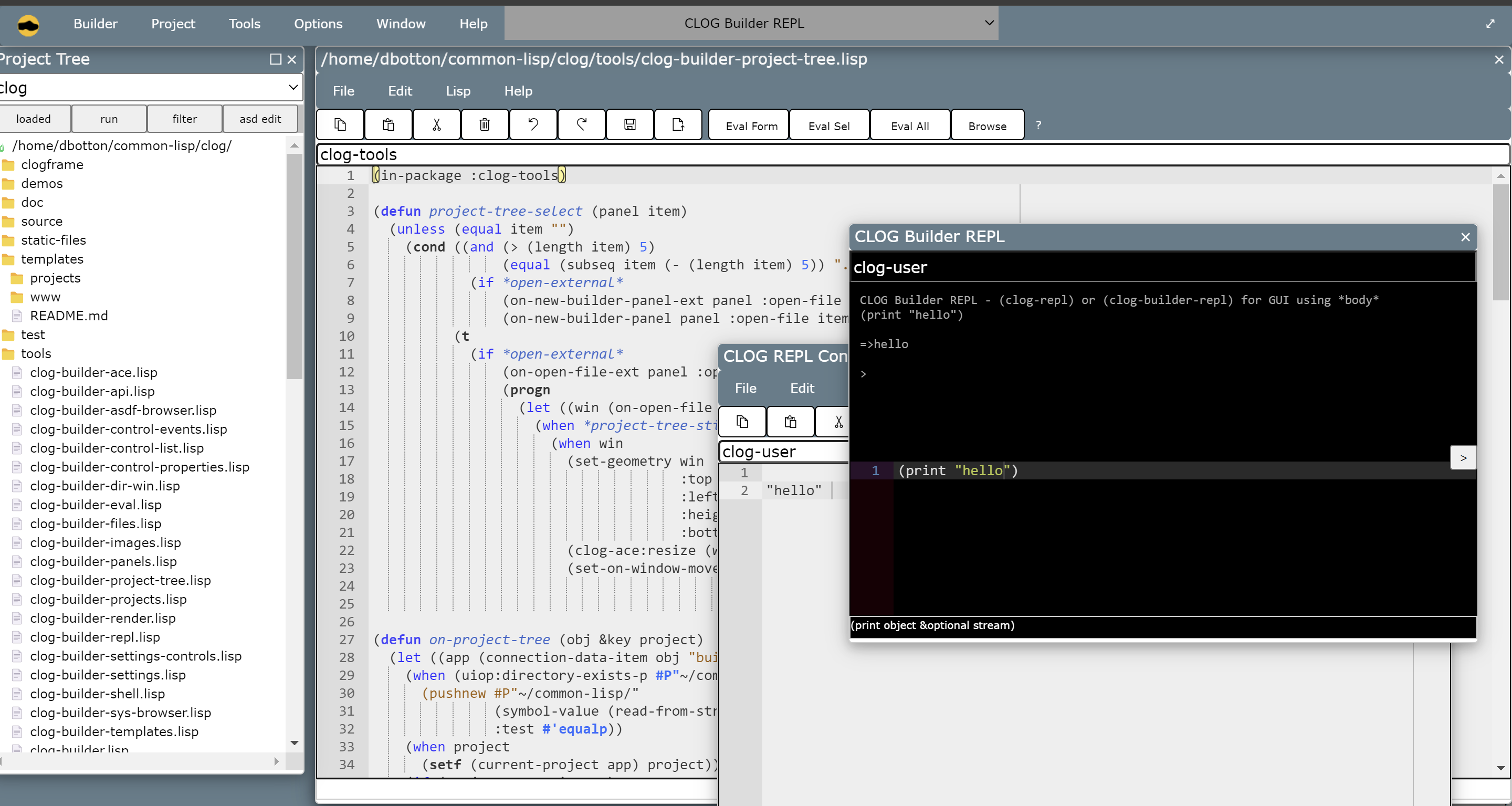
You can also open a "clog-repl" window in your browser to play from the common-lisp repl:
CL-USER> (in-package clog-user)
CLOG-USER> (clog-repl)
CLOG-USER> (setf (background-color *body*) "beige")
CLOG-USER> (create-div *body* :content "Hello World!")
The clog-repl URL is http://127.0.0.1:8080/repl body will always refer to the last access of that URL.
To open a browser with the CLOG manual:
CL-USER> (clog:open-manual)
Work your way through the tutorials. You will see how quick and easy it is to be a CLOGer.
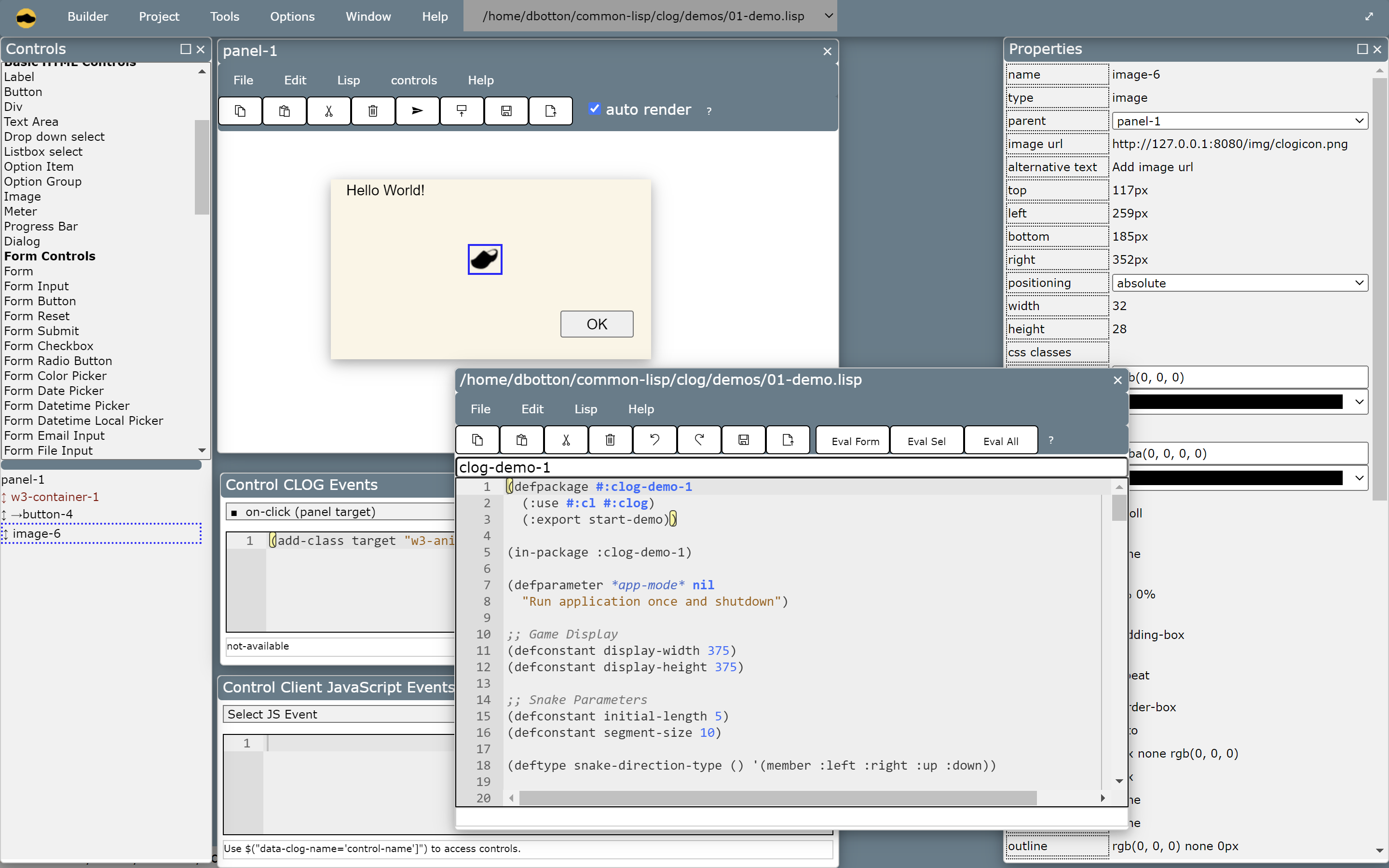
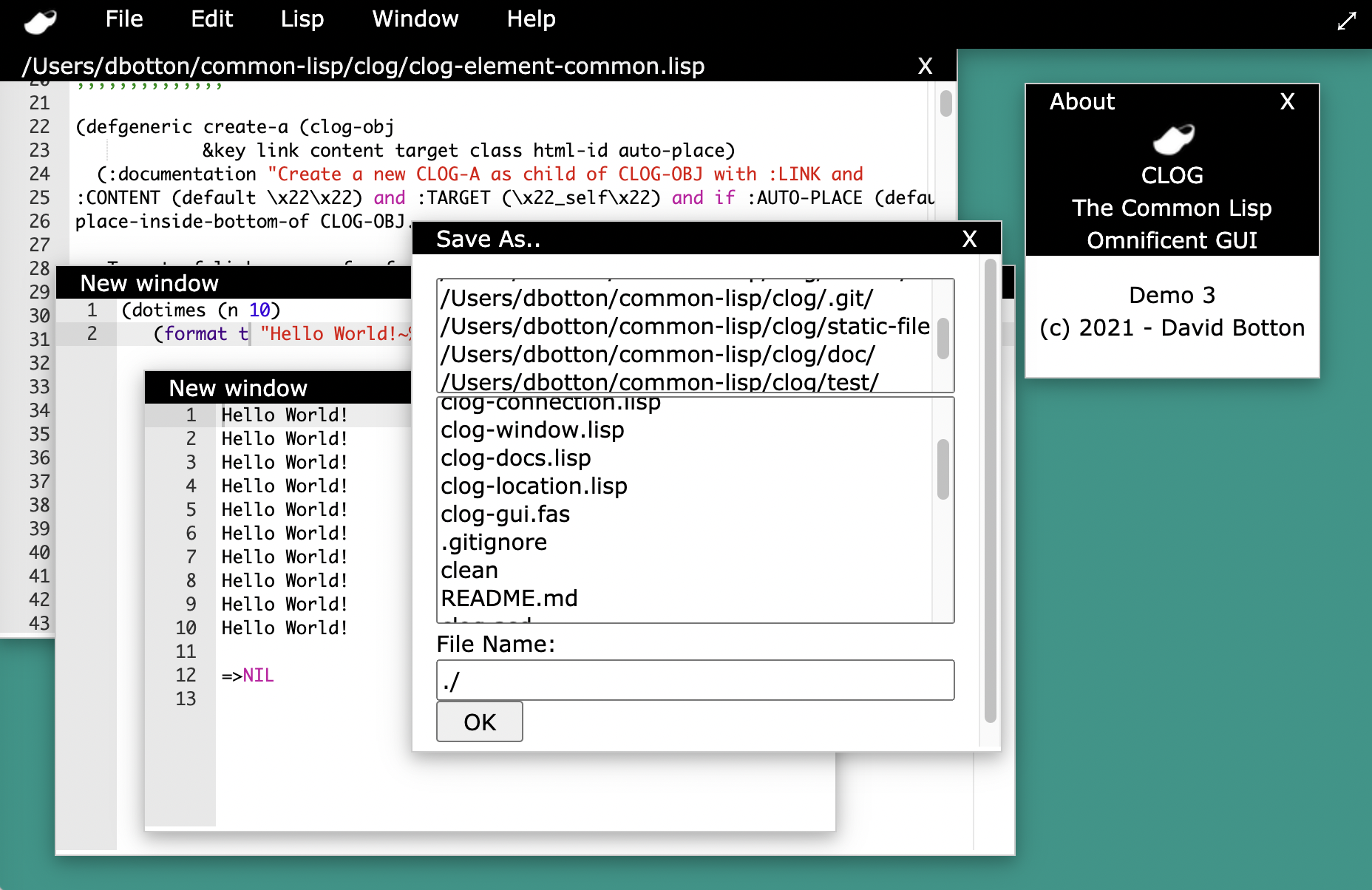
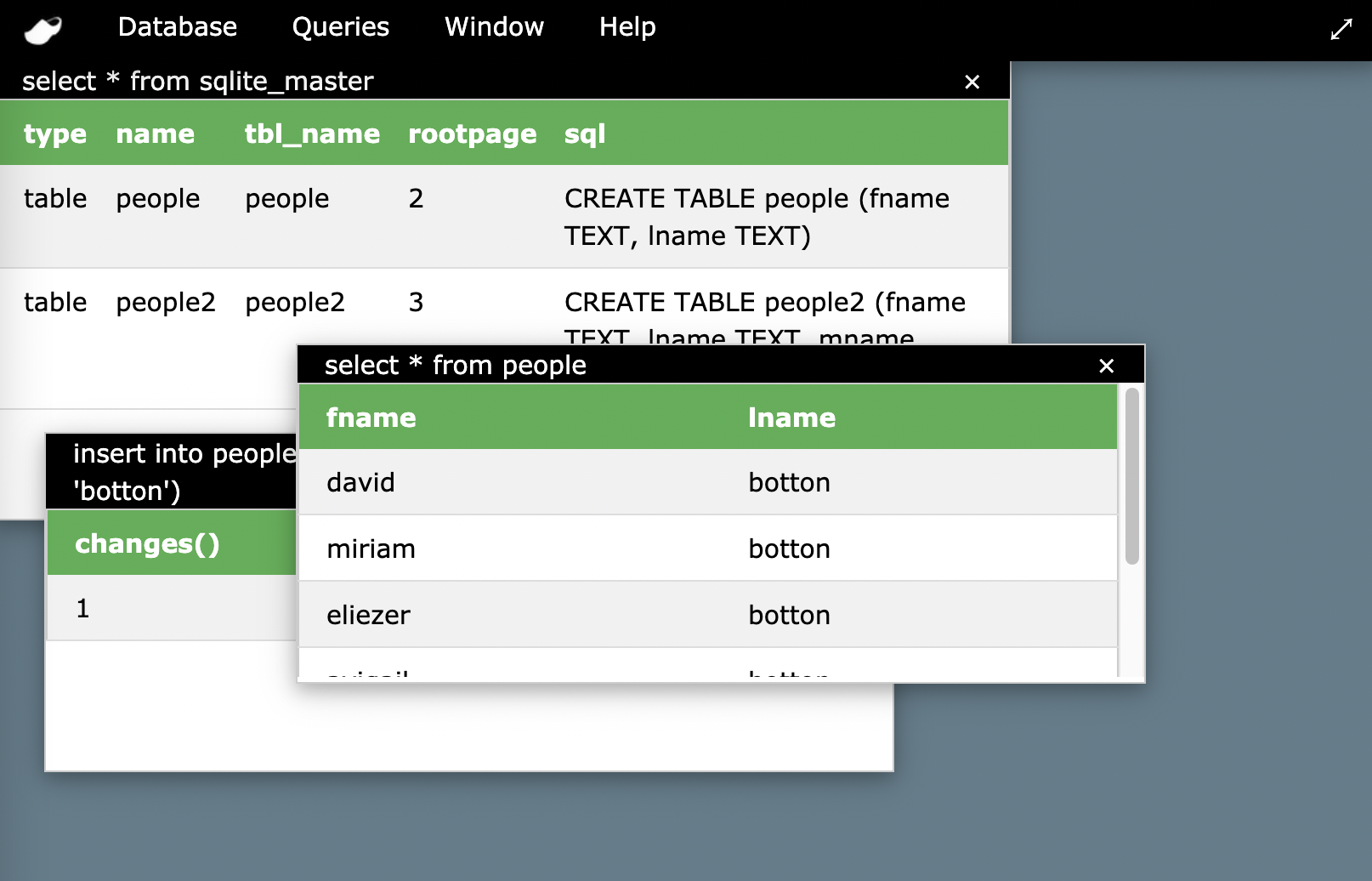
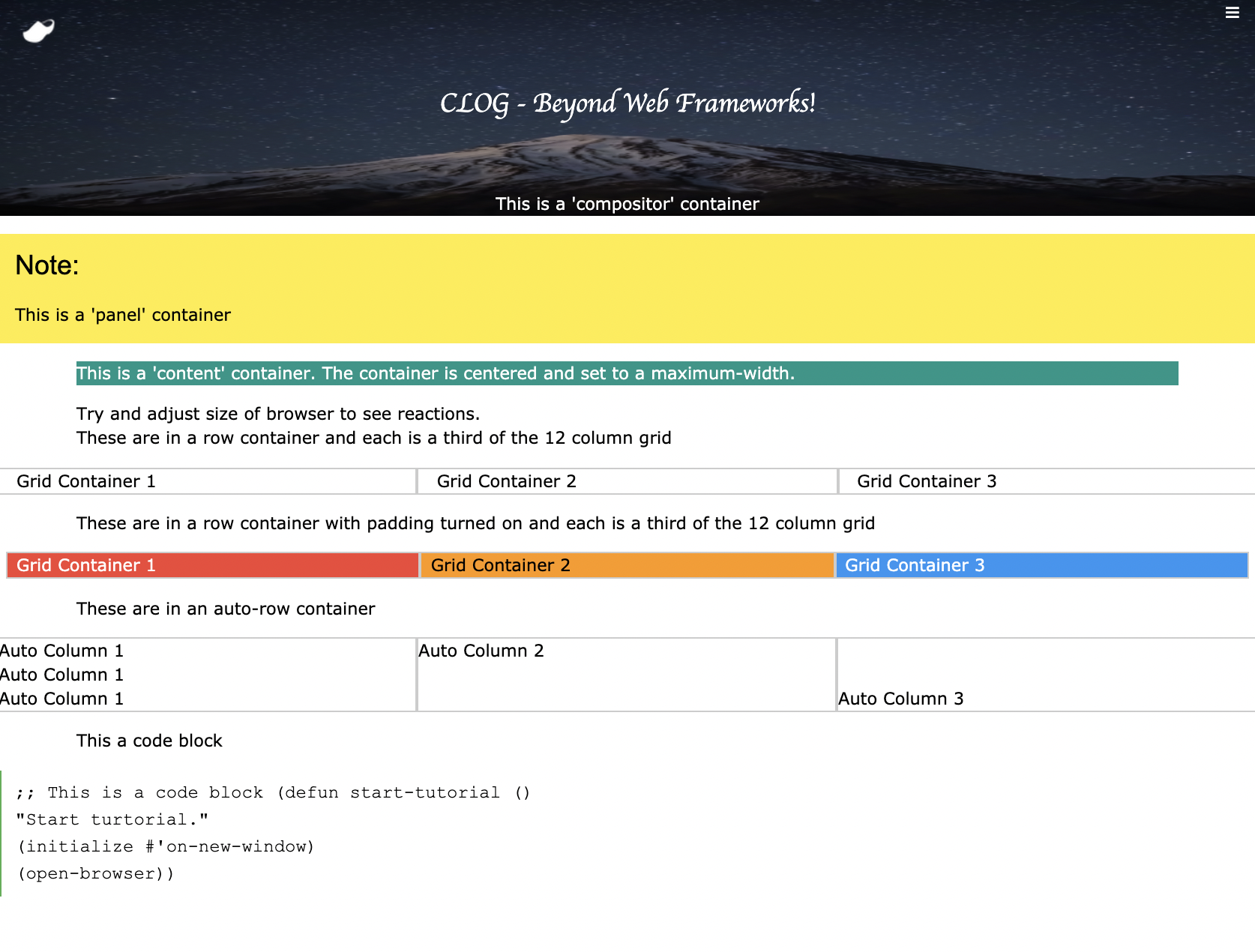
Here is a sample CLOG app:
(defpackage #:clog-user               ; Setup a package for our work to exist in
  (:use #:cl #:clog)                  ; Use the Common Lisp language and CLOG
  (:export start-tutorial))           ; Export as public the start-tutorial function

(in-package :clog-user)               ; Tell the "reader" we are in the clog-user package


;; Define our CLOG application
(defun on-new-window (body)           ; Define the function called on-new-window
  "On-new-window handler."            ; Optional docstring to describe function

  (let ((hello-element                ; hello-element is a local variable that
                                      ; will be bound to our new CLOG-Element

      ;; This application simply creates a CLOG-Element as a child to the
      ;; CLOG-body object in the browser window.

      ;; A CLOG-Element represents a block of HTML (we will later see ways to
      ;; directly create buttons and all sorts of HTML elements in more
      ;; lisp-like ways with no knowledge of HTML or JavaScript.
      (create-child body "<h1>Hello World! (click me!)</h1>")))

    (set-on-click hello-element      ; Now we set a function to handle clicks
          (lambda (obj)              ; In this case we use an anonymous function
            (setf (color hello-element) "green"))))))

;; To see all the events one can set and the many properties and styles that
;; exist, refer to the CLOG manual or the file clog-element.lisp


(defun start-tutorial ()   ; Define the function called start-tutorial
  "Start tutorial."        ; Optional docstring to describe function

  ;; Initialize the CLOG system
  (initialize #'on-new-window)
  ;; Set the function on-new-window to execute
  ;; every time a browser connection to our app.
  ;; #' tells Common Lisp to pass the function
  ;; to intialize and not to execute it.


  ;; Open a browser to http://12.0.0.1:8080 - the default for CLOG apps
  (open-browser))
Other samples of CLOG on the web:
Websites/apps made with CLOG
- clogpower.com
- ackfock.com
CLOG Builder Tutorials
- Chat App https://www.reddit.com/r/lisp/comments/sj1tv5/clog_builder_tutorial_1_a_chat_app_from_start_to/
- Building a Web Page https://www.reddit.com/r/lisp/comments/sn8j77/clog_builder_tutorial_2_building_a_web_page/
- Importing HTML in to Builder, Adding Pages and Hand Coding https://www.reddit.com/r/lisp/comments/snvv0w/clog_builder_tutorial_3_importing_html_adding/
- CLOS-CONTACT - Using database controls demos a contact manager app in clog. https://www.reddit.com/r/lisp/comments/t61sib/clog_builder_tutorial_4_a_complete_database_app/
- Using and Creating Custom Controls https://www.reddit.com/r/lisp/comments/w2d6dr/builder_tutorial_5_using_and_creating_lisp_custom/
CLOG Tutorials
- 01-tutorial.lisp - Hello World
- 02-tutorial.lisp - Closures in CLOG
- 03-tutorial.lisp - Events fire in parallel
- 04-tutorial.lisp - The event target, reusing event handlers
- 05-tutorial.lisp - Using connection-data-item
- 06-tutorial.lisp - Tasking and events
- 07-tutorial.lisp - My first CLOG video game (and handling disconnects)
- 08-tutorial.lisp - Mice Love Containers
- 09-tutorial.lisp - Tabs, panels, and forms
- 10-tutorial.lisp - Canvas
- 11-tutorial.lisp - Attaching to existing HTML
- 12-tutorial.lisp - Running a website in CLOG (routing)
- 13-tutorial/ - Flying Solo - A minimalist CLOG project
- 14-tutorial.lisp - Local (persistent) and Session client-side storage
- 15-tutorial.lisp - Multi-media
- 16-tutorial.lisp - Bootstrap 4, Loading css files and javascript
- 17-tutorial.lisp - W3.CSS layout example and Form submit methods
- 18-tutorial.lisp - Drag and Drop
- 19-tutorial.lisp - Using JavaScript components
- 20-tutorial.lisp - New CLOG plugin from JavaScript component
- 21-tutorial.lisp - New CLOG plugin in Common-Lisp
- 22-tutorial.lisp - CLOG GUI Menus and Desktop Look and Feel
- 23-tutorial.lisp - Using semaphores to wait for input
- 24-tutorial.lisp - CLOG WEB containers
- 25-tutorial.lisp - A "local" web app using CLOG WEB
- 26-tutorial.lisp - A web page and form with CLOG WEB
- 27-tutorial.lisp - Panel Box Layouts
- 28-tutorial/ - CLOG Builder Hello - A minimalist CLOG Builder project
- 29-tutorial.lisp - Presentations (and jQuery) - linking lisp objects to clog objects
- 30-tutorial.lisp - Instant websites - clog-web-site
- 31-tutorial.lisp - Database and Authority based websites - clog-web-dbi and clog-auth
- 32-tutorial.lisp - Database Managed Content websites - clog-web-content
- 33-tutorial.lisp - with-clog-create - Using a declarative syntax for GUIs
- 34-tutorial.lisp - 2D WebGL example
- 35-tutorial.lisp - 3D WebGL example
CLOG Demos
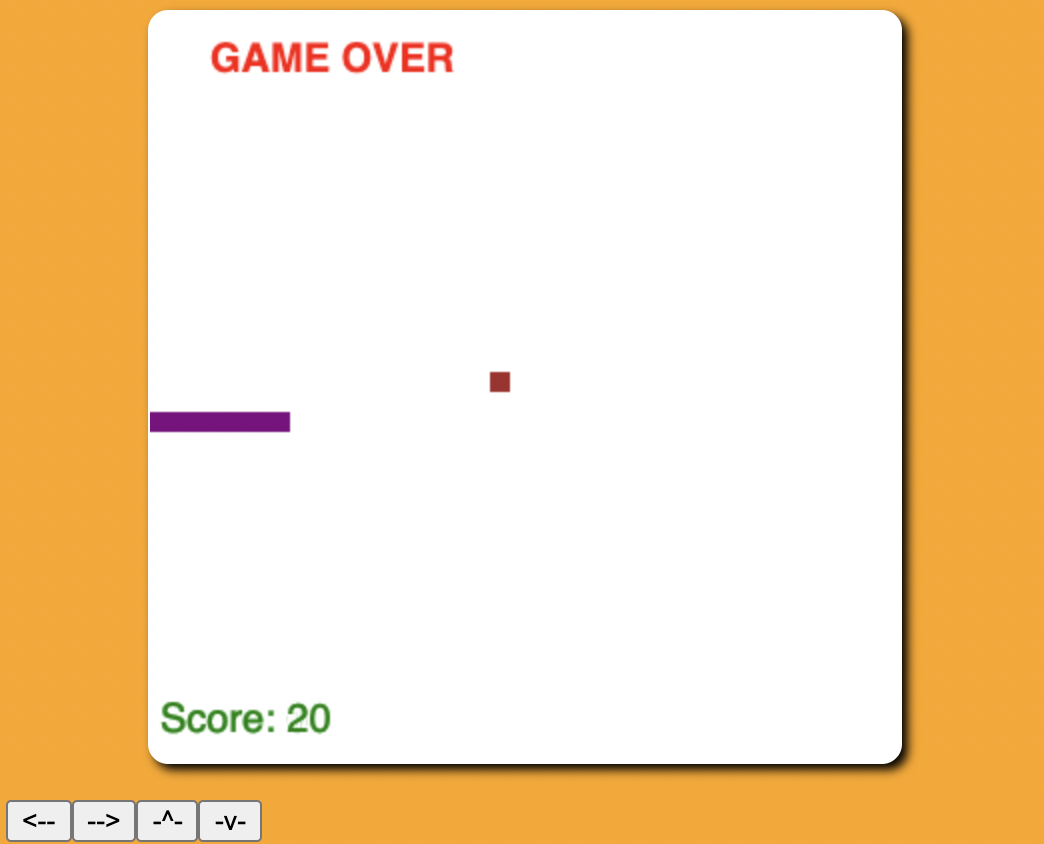
- 01-demo.lisp - Sparkey the Snake Game
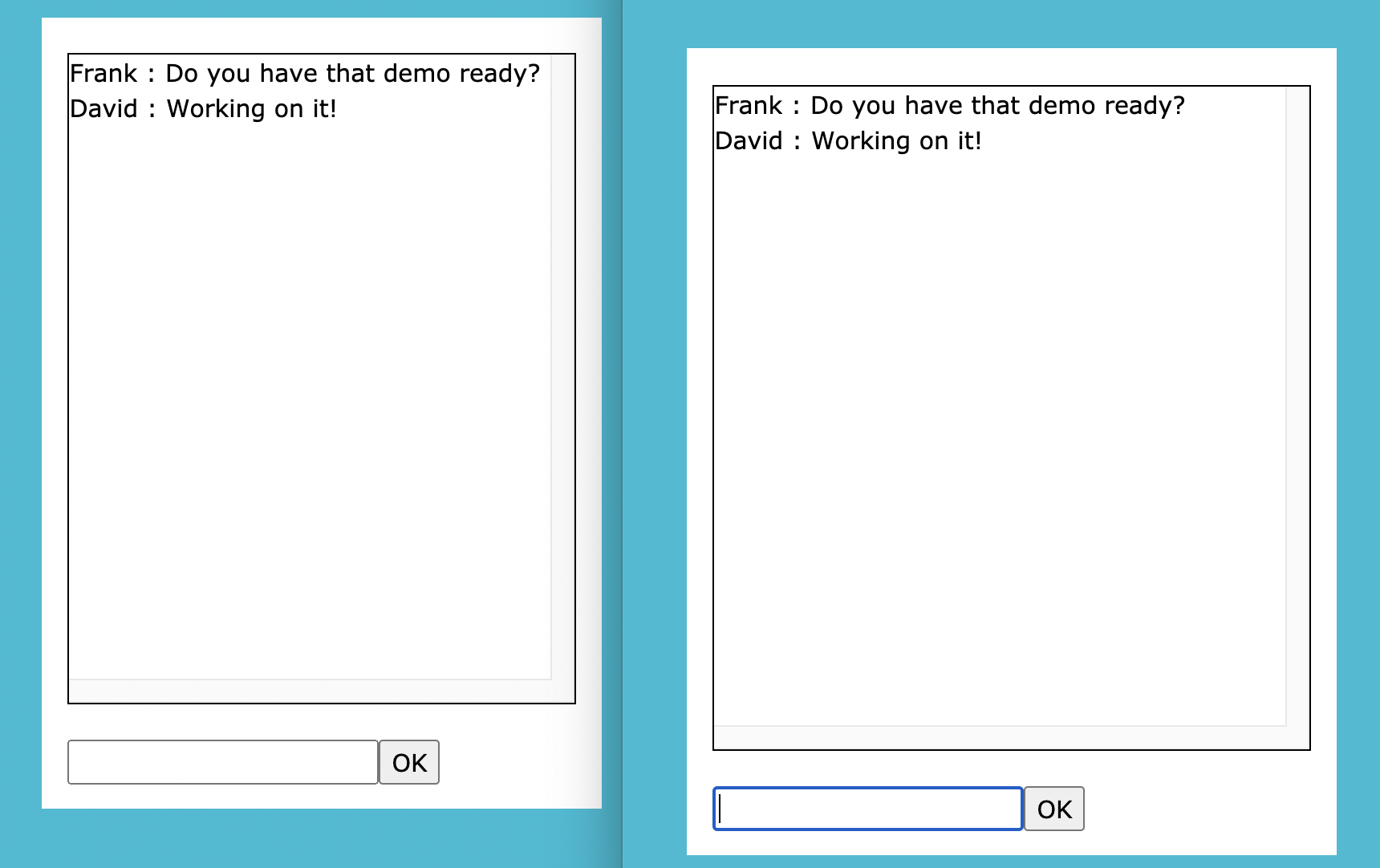
- 02-demo.lisp - Chat - Private instant messenger
- 03-demo.lisp - IDE - A very simple common lisp IDE
- 04-demo.lisp - CMS Website - A very simple database driven website
CLOG Video Series - CLOG Plunger
- CLOG Plunger - Episode 1 - Flow - The real secret to Common Lisp productivity.
- CLOG Plunger - Episode 2 - The prequel
- CLOG Plunger - Episode 3 - A new menu item and a draggable Index Card
- CLOG Plunger - Episode 4 - Panels are classes
- CLOG Plunger - Episode 5 - Selectedp and make-resizable
- CLOG Plunger - Episode 6 - Adding a cork board and data URIs
- CLOG Plunger - Episode 7 - Add card, Delete cards, Edit Cards
- CLOG Plunger - Episode 8 - Moving data in and out of cards
- CLOG Plunger - Episode 9 - File save and load
- CLOG Plunger - Episode 10 - Moving the board to a component with save, load, delete of cards
- CLOG Plunger - Episode 11 - Debugging Race Conditions
CLOG Extras - Supplementary Video Series
- CLOG Extra 1 - What is Eval Form / Eval Sel / Eval All in the builder?
- CLOG Extra 2 - The CLOG Plugin - CLOG-Plotly
- CLOG Extra 3 - The CLOG Project System
- CLOG Extra 4 - All about panels
Common Lisp The Language - Supplementary programming tutorials
A series covering Common Lisp, highlighting key points and discussions on using the key reference to Common Lisp. Quick paced and intended for review further work on mastering the power of Common using the book: Common Lisp The Language 2nd Edition by Guy L. Steele
- Common Lisp The Language 2nd Edition - Episode #1 - Covers Preface, Chp 1 and 2
- Common Lisp The Language 2nd Edition - Episode #2 - Covers Chp 3 - Scope and Extent
- Common Lisp The Language 2nd Edition - Episode #3 - Covers Chp 4 - Type Specifiers
- Common Lisp The Language 2nd Edition - Episode #4 - Covers Chp 5 - Program Structure
- Common Lisp The Language 2nd Edition - Episode #5 - - Covers Chp 6 - Predicates
Tool Summary
- clog-builder - Rapid visual interactive development for Web and GUIs
- clog-db-admin - SQLite3 admin tool
High Order Extensions to CLOG
-
clog-gui - Desktop over the web
- Menus
- Windowing system
- Modal windows, Keep-on-top windows
- File Load / Save dialogs
- Alert, Input and Confirmation dialogs
- Form dialogs
-
clog-web - Webpage creation
- Auto column layouts
- 12 Point Grid System layouts
- Content containers
- Panels
- Sidebar menus
- Compositor containers
- Menus
- Alerts
-
clog-web-site - Instant themed websites with plugins:
- clog-web-page - create a theme based page
- clog-web-dbi - database driven websites (uses clog-auth)
- clog-web-forms - Instant web forms
- clog-web-themes - basic themes for clog based websites
- clog-web-content - database driven content,tags, comments (in progress)
- clog-web-blog - instant blogs (in progress)
- clog-web-cart - instant shopping carts (future)
-
clog-panels - Quick application layouts
-
clog-presentations - bi-directional linking of Lisp Objects and CLOG Objects
-
clog-jquery - DOM queries
-
clog-data - Move data to and from groups of controls
- SQL writer helpers for basic SQL
- CLOG-Database - Database control for CLOG Builder
- CLOG-One-Row - One row at a time table access auto binds to controls in CLOG Builder
- CLOG-Lookup - Version of the select control (dropdown and listbox) that are database connected
- CLOG-DB-Table - Version of html table that are database connected
-
clog-auth - Authentication and authorization framework
-
clog-plugin - Custom Control Plug-in template for Builder and CLOG